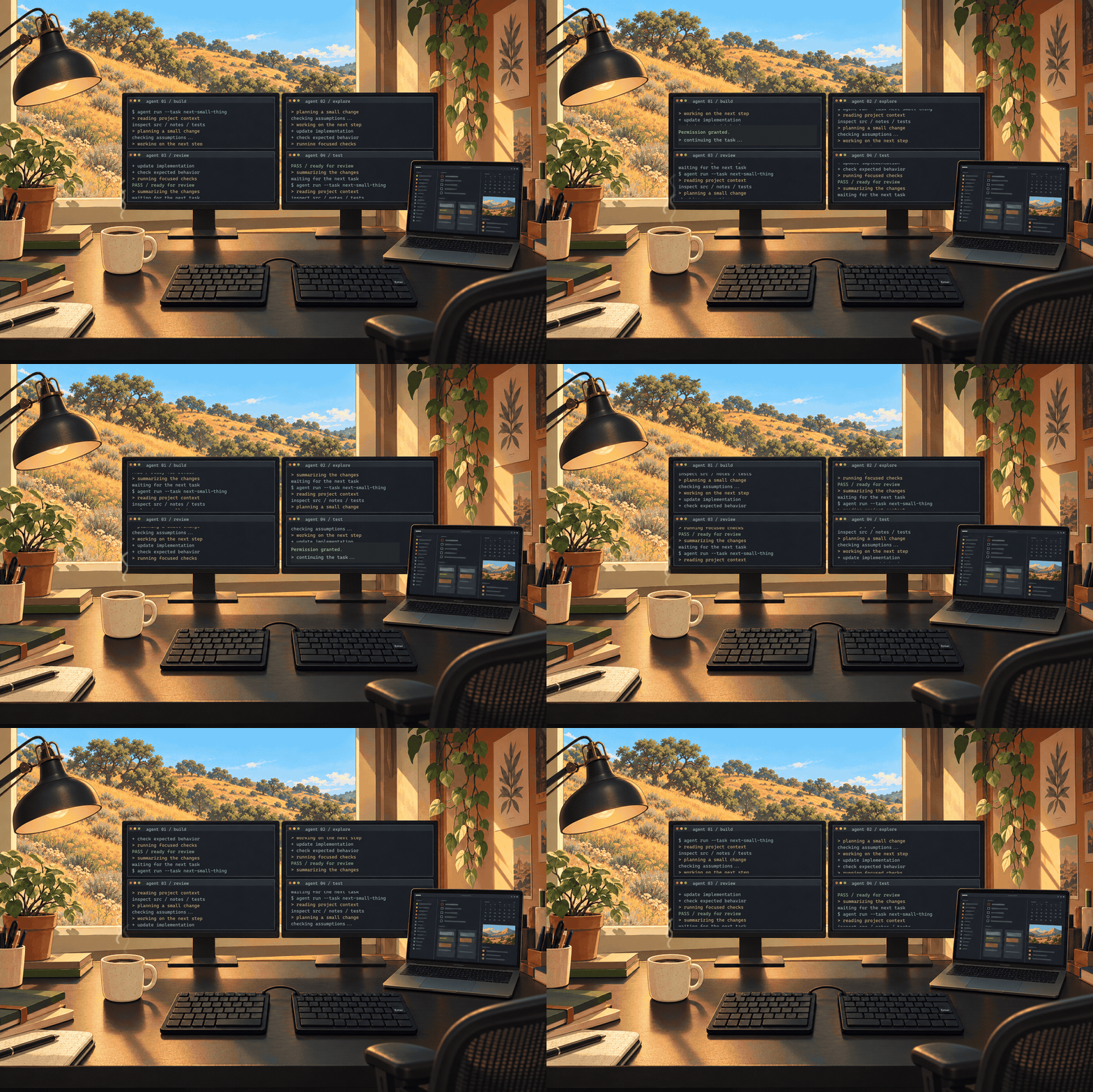
I am spread too thin.
The frustrating part is that I like a lot of what is spreading me thin. Work gives me fulfillment. So do sidequests. I like learning something, building something, and seeing an idea become real. I don't want to give that up.
But I do need to relax. Slow down. Work at a pace I can keep.
That is the balance I am trying to find when I think about burnout. How do I keep doing work I care about without filling every available part of my life with it?
It is easy to keep the agents busy
AI makes this harder in a way I didn't fully expect.
There is a strong temptation to orchestrate agents constantly. Define another task. Start another thread. Check what came back. Give it a little more direction. There is always something else that could be moving.
And I enjoy that. Getting an idea out of my head and into a working version is satisfying. When the distance between those two things gets shorter, more ideas feel worth trying.
The catch is that starting work creates more work for me later. A result needs attention. A decision needs context. A promising experiment suggests another experiment.
Even when an agent is doing the implementation, I still have to decide what matters and what to do with the result. I wrote about that in The Human Stays Sequential. The human side of that constraint feels especially relevant here.
I can have more work happening at once without having more capacity to care about it all.
There is also a subtle pressure in having tools that can keep working. If I could start something before dinner and have a result afterward, leaving that opportunity unused can feel wasteful.
I need to get more comfortable leaving it unused.
A few things I want to try
I don't have a finished system for this. These are a few boundaries I want to practice.
Keep fewer things active. I need a place to put ideas without turning each one into a commitment. Writing an idea down should be enough sometimes. For sidequests, I want to get in the habit of finishing or deliberately pausing something before starting another. A project can be worth doing and still wait.
Decide when to stop before I start. "One more thing" is a poor stopping rule when there is always another thing. A specific task or a time to close the laptop gives me a boundary I can actually recognize. If an agent finishes afterward, its result can wait until I come back.
Leave some time unassigned. I want room to take a walk, sit around, or do something with no useful output attached. I don't need to turn every break into a strategy for getting more work done later. I want to be able to enjoy the break itself.
Let some of the speed become free time. If AI helps me finish something sooner, I want to occasionally keep the time I saved. It is easy to immediately spend it on another task. I would like finishing early to sometimes mean being done.
None of these requires a better orchestration setup. They require me to make choices about how much I take on, including when the work is interesting.
I want to keep enjoying this
The fulfillment is real. So is the need to rest.
I don't think the answer is to become less curious or stop building things on the side. I want those things in my life. I also want enough room around them that they keep feeling like things I chose.
That means accepting that some good ideas will sit untouched. Some agents will be idle. Some evenings will end without another result to review.
I want to finish a day with enough energy to enjoy the rest of it, and come back to the work because I want to. That is the pace I am trying to find.