I am getting more interested in a narrower and more practical question than "what can AI do?"
The better question is:
what is the right working relationship between me and the system?
I keep seeing people frame AI adoption as a question of replacement.
Can it do the whole task?
Can it finish the work without me?
Can I hand it over and stay out of the loop?
That is sometimes the right question.
But in a lot of real work, it is the wrong one.
This week I had a useful reminder of that while working through an internal permitting exercise in ArcGIS Pro.
The interesting decision was not whether the AI could complete the task end to end.
It was that I deliberately did not want it to.
I wanted something more precise.
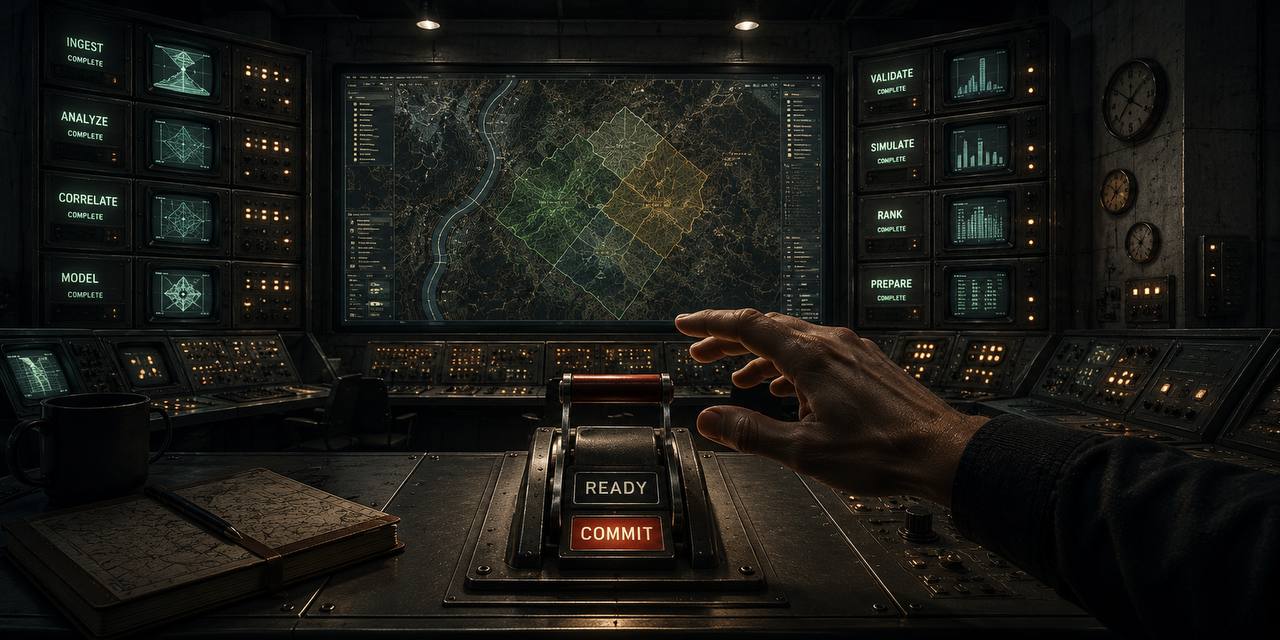
I wanted the system to set me up to do the work quickly and almost effortlessly, while I kept control of the actual irreversible edit.
That boundary turned out to matter a lot.
The useful outcome was setup, not completion
What I needed was not a magic autonomous finish.
I needed:
- the right map in ArcGIS Pro
- the right features in view
- the right bookmarks already staged
- enough structure that I could step in and make the edit confidently
Nothing more, nothing less.
That is a more modest ambition than "AI completed the workflow," but it is also much more useful.
It removed friction.
It removed hunting.
It removed setup cost.
It removed a bunch of boring spatial orientation work that usually burns time before the real decision even starts.
And because the system stopped at the boundary instead of crossing it, I still knew exactly what I was authoring.
The human boundary is where the trust lives
I think this is one of the more important boundaries in practical AI work.
There is a big difference between:
- AI did the work for me
- AI prepared the work so I could do it cleanly
The second one is not a compromise.
In a lot of serious environments, it is the better pattern.
It preserves speed without pretending accountability disappeared.
It gives you leverage without making the authorship muddy.
It keeps the irreversible step attached to the human who understands the consequences.
That is the boundary I want more of.
I am less interested in autonomy than in collaboration
This feels like a new craft I am still learning.
The skill is not just prompting well.
It is not just knowing which model is smart.
It is not even just building the tool.
The skill is learning how to collaborate with AI in a way that is proportionate to the work.
Sometimes that means full automation.
Sometimes that means asking for analysis.
Sometimes that means letting the system draft a structure, create a first pass, or set up an environment.
And sometimes, like here, it means having the AI prepare the exact surface I need so I can do the real work faster and with less drag.
That is not failure to automate enough.
That is better judgment about where the machine should stop.
The most useful AI often leaves the last move to you
There is a version of the AI story that is obsessed with completion.
Finish the task.
Remove the human.
Close the loop.
I think a lot of the better real-world story is about positioning instead.
Get me to the right place.
Put the right evidence in front of me.
Set the stage.
Reduce the wasted motion.
Then let me make the move that actually matters.
That is what happened here.
The value was not that the AI completed the work.
The value was that it made the work feel almost ready before I touched it.
I think that is a more honest and more durable model of adoption than a lot of the louder autonomy rhetoric.
The AI set the stage.
I still made the call.